The packaging journal — 2027 outlook
7 Packaging TrendsGrowing BrandsShould Prepare for in 2027
A practical filter for the packaging decisions that may affect your next order—and the visual trends you can afford to ignore.
By Foldelle Packaging · · 10 min read
See the seven directions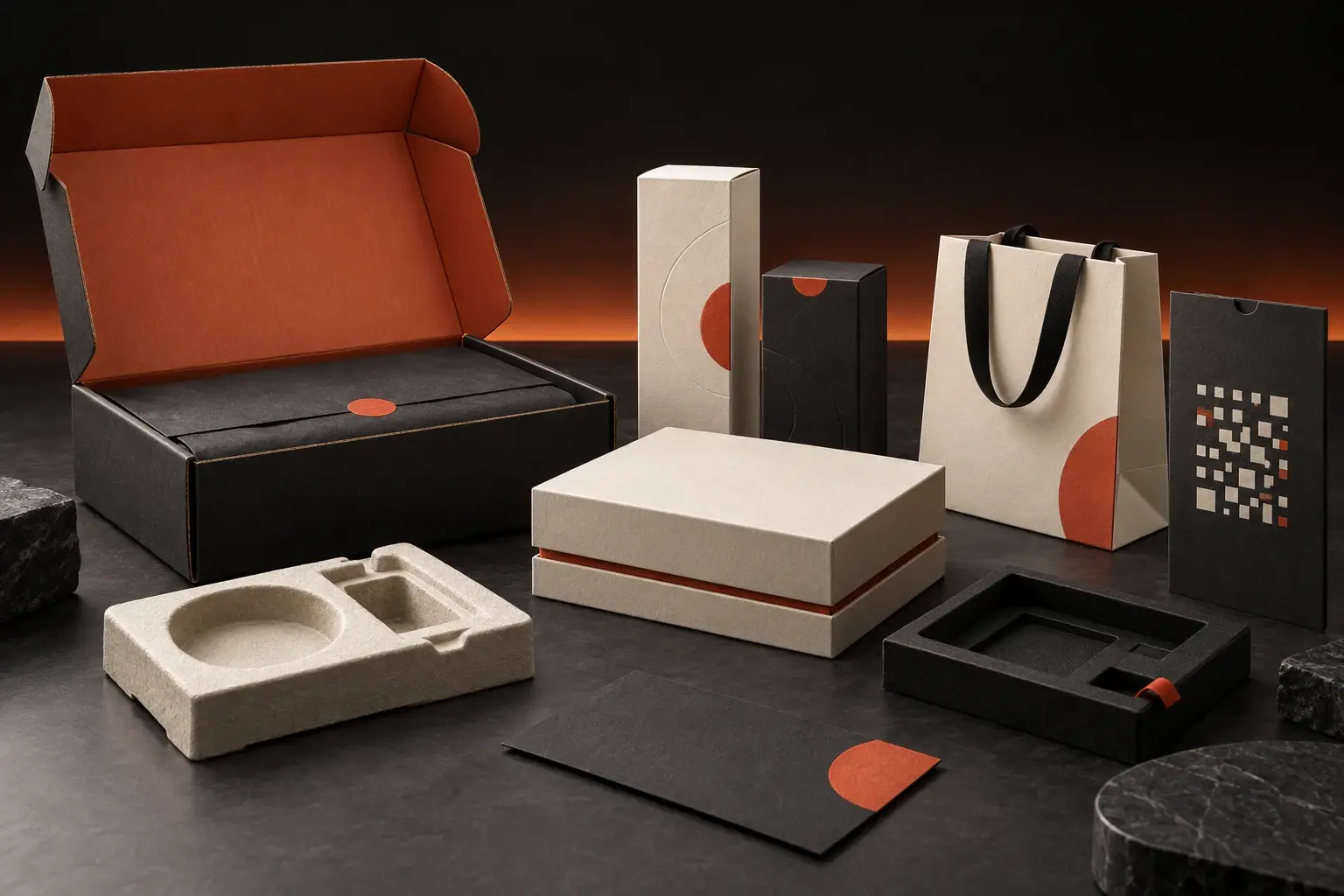
From aesthetic to operating decision
Packaging trends are becoming business decisions.
Packaging conversations used to begin with color, graphics and the unboxing moment. Those choices still matter, but material use, shipping performance, recyclability, labeling technology and market expectations now influence the brief much earlier.
Growing beauty, fragrance, jewelry, accessories, gift and ecommerce brands need packaging that looks considered, protects the product and remains practical to produce. The directions below are forward-looking judgments based on developments visible in 2026—not guaranteed predictions or a checklist every brand must follow.
01 / The short version
2027 packaging trends at a glance
Treat each trend as a question for the brief, not a design instruction.
| Trend | Why it matters | What to do |
|---|---|---|
| 01Right-sized packaging | Less empty space and material | Review product and internal dimensions |
| 02Evidence-based sustainability | Broad claims carry greater risk | Use specific, supportable language |
| 03Design for recyclability | Construction matters as much as material | Simplify or separate components |
| 04Ecommerce-ready performance | Delivery damage affects cost and trust | Test structure and inserts |
| 052D barcodes | Packaging carries more information | Reserve space early |
| 06Restrained premium design | Luxury does not require excess | Use material and detail selectively |
| 07Adaptable packaging systems | Growing brands need flexibility | Design for multiple SKUs and reorders |
02 / Trend 1
Right-sized packaging replaces oversized presentation

Right-sizing begins with the actual product—not a box selected from a mood board. Accurate product dimensions and weight help establish the internal box size, the protection needed and whether a compact custom insert can replace layers of void fill. A smaller pack can reduce board, insert material, storage space and shipping volume.
This does not mean removing protection. Glass bottles, delicate finishes and multi-piece sets still need retention and clearance. The aim is to remove space that performs no useful function while preserving protection and a deliberate opening sequence. EU packaging rules now emphasize minimising packaging volume and weight, including unnecessary ecommerce empty space, while maintaining functionality.
Small changes in three dimensions add up.
Length × width × height determines this comparison. Product fit and protection still need to be tested.
Illustrative dimensions only; separate from the photo. Volume reduction is not a freight-price or material-saving guarantee.
03 / Trend 2
Sustainability claims need more evidence
Broad words such as “green,” “planet-friendly” or “eco” can hide more than they explain. A more useful packaging statement identifies the feature: a specified percentage of recycled content, a reduction compared with the previous pack, a reusable construction, or components designed to be separated.
Paper-based packaging is not automatically recyclable in every market. Local collection systems, coatings and mixed components matter. Ask suppliers for documentation that supports the material description, then have market-specific claims reviewed by the people responsible for compliance. The US Federal Trade Commission, for example, warns against broad unqualified environmental benefit claims and expects marketers to substantiate specific claims.
From an environmental idea to a supportable statement.
- 01
Define
Name the material or feature.
- 02
Document
Obtain supporting evidence.
- 03
Check
Review the sales market.
- 04
Communicate
Use a precise claim.
04 / Trend 3
Recyclability begins with the complete structure
Review the whole pack, layer by layer.
- 01 / Surface & finishPaper, coatings, lamination and decorative effects.
- 02 / Structure & closureBoard, adhesives, magnets and windows.
- 03 / Insert & protectionMaterial, product retention and separability.
Conceptual layer diagram. Recyclability depends on the complete specification and local collection systems.
The visible paper is only one part of a package. Magnets, plastic windows, foam inserts, film lamination, metallic effects and adhesives can change how the complete pack enters a waste stream. A mono-material direction may simplify the story, but only if the structure still protects the product and works with relevant collection and sorting systems.
Where mixed components remain necessary, consider whether a customer can separate them without tools or guesswork. Compare a paperboard insert with other protective materials, question whether a window is essential, and document each layer. Requirements differ by market, so “designed for recyclability” should lead to a component review—not a universal promise.
05 / Trend 4
Ecommerce packaging must protect and present
An ecommerce package can be a shipping format, a brand touchpoint, or both. Its closure must stay secure; the product should not move, rub or crush; and the opening sequence should not weaken the structure. Decorative corners, protruding hardware and delicate surface treatments that look impressive in a studio can arrive scuffed.
Review the expected fulfillment environment: how the pack is assembled, where labels are applied, how it is stacked and whether a presentation box still needs an outer shipping carton. Mondi’s 2026 ecommerce research reports that protection remains essential to consumers while sustainable packaging expectations also remain high. That tension is why a successful pack must be assessed as a system.
06 / Trend 5
2D barcodes become part of packaging design
GS1’s ambition for the end of 2027 is for retail point-of-sale systems to process defined 2D barcodes alongside existing one-dimensional barcodes. This is an industry transition goal, not a rule that every small brand must print a QR code. A decorative QR code that opens a campaign page is also different from a standards-based symbol carrying structured product data.
If a retailer or product program requires a 2D barcode, reserve space early. Size, contrast, quiet zone, substrate, finish and curvature can affect scan quality. Coordinate the data owner, designer, printer and relevant market partner before production, then verify the code on a physical printed sample. Requirements depend on the product, retailer and market.
Give product information a planned place.
Layout schematic, not a barcode or a print-ready specification.
07 / Trend 6
Premium packaging becomes more restrained and tactile
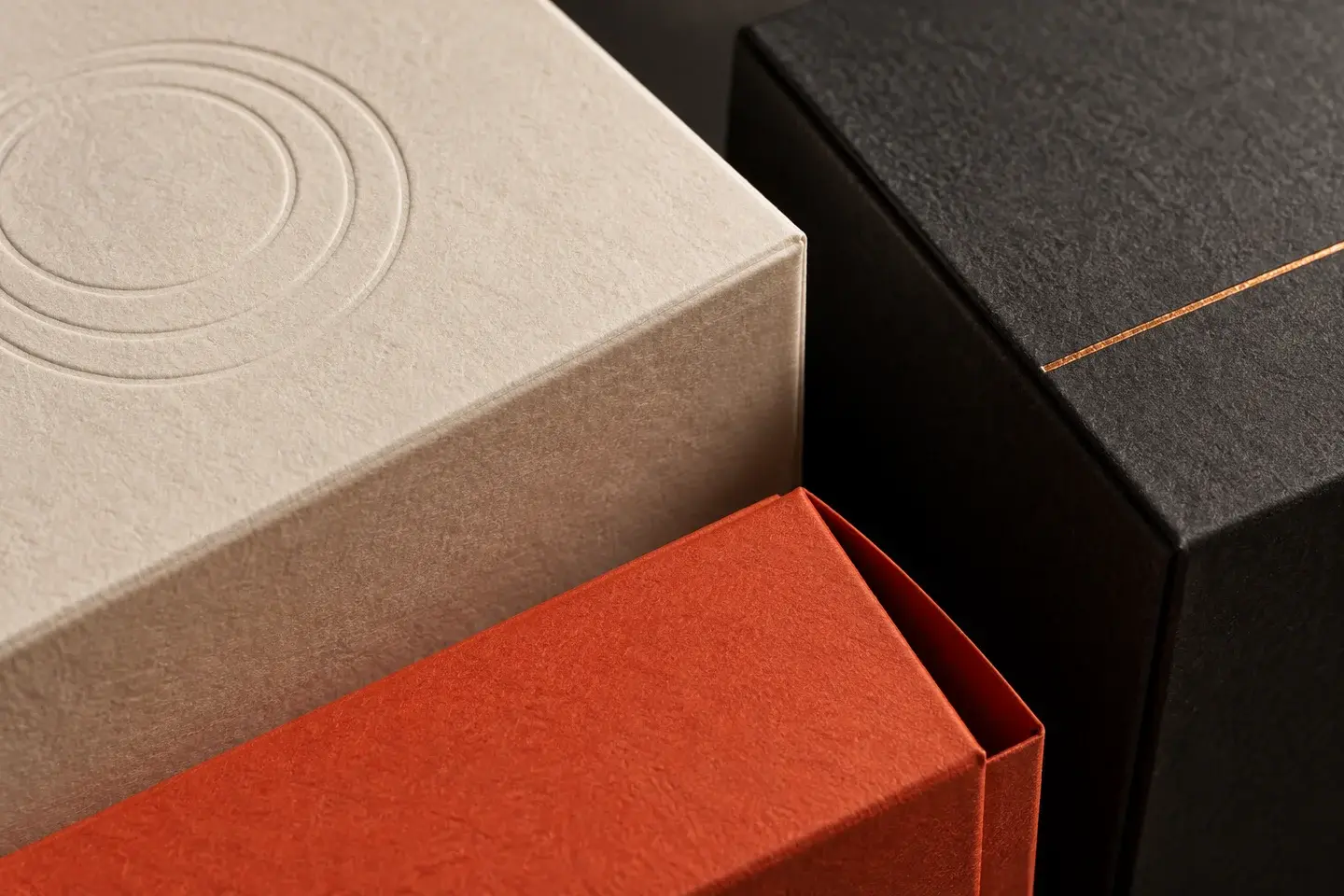
This is a design-direction judgment, not a settled global fact: premium packs are increasingly convincing when proportion, paper and one controlled detail do the work. Uncoated or textured papers, blind embossing, disciplined typography, whitespace and a small foil accent can feel more coherent than stacking every finish onto one surface.
Restraint is not the same as easy production. Minimal graphics expose misaligned edges, uneven wraps, color variation and imperfect registration. The brief still needs clear color standards, finish locations and approval criteria. Use a finish because it supports hierarchy or touch—not because it appears on a trend board.
08 / Trend 7
Adaptable packaging systems support brand growth
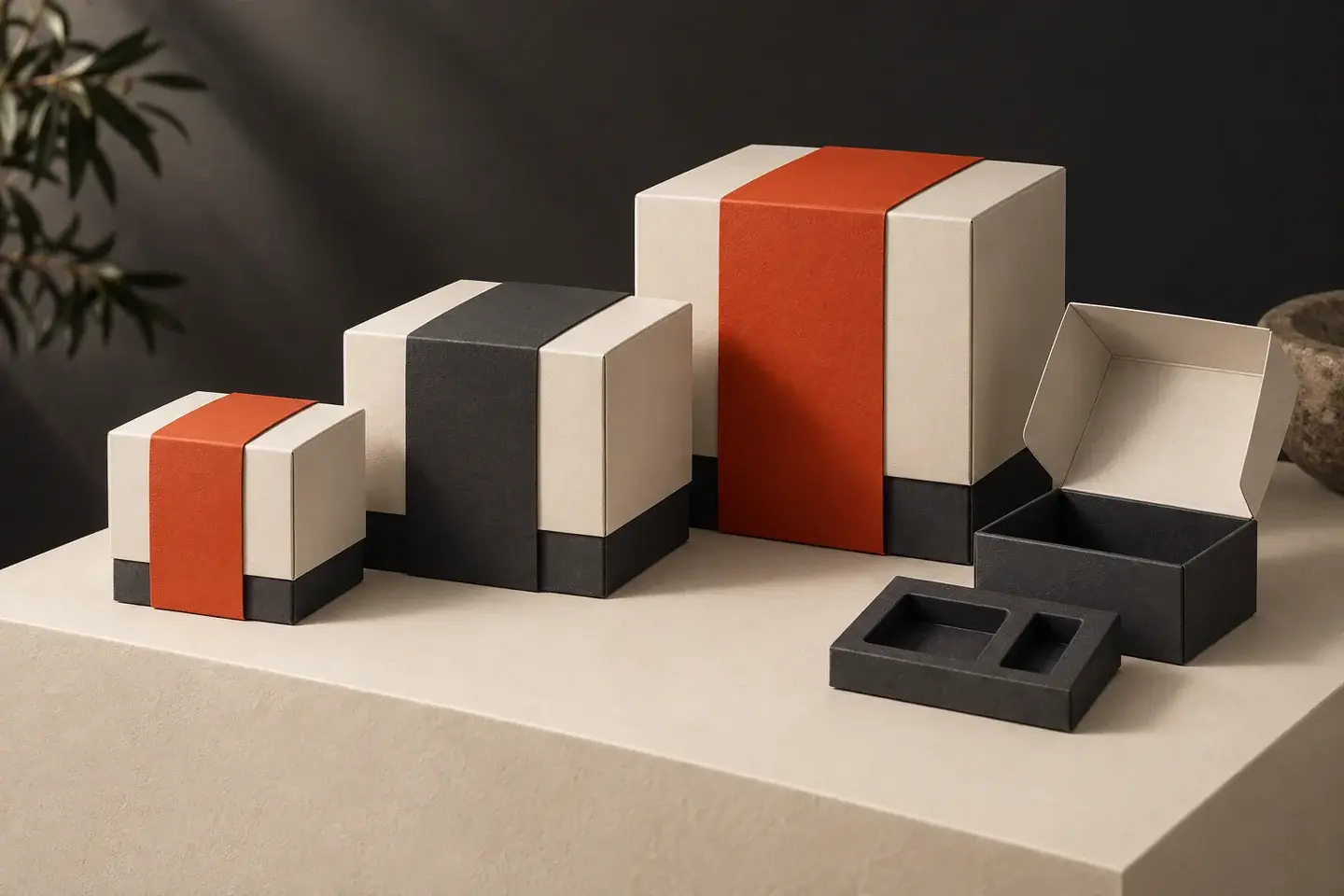
A growing brand rarely stops at one product. Instead of developing each box in isolation, plan a packaging family: consistent structures across related sizes, repeatable material and color standards, and defined areas where artwork, sleeves, labels or inserts can change.
This does not require one universal box. The aim is controlled variation. Record approved dimensions, board, papers, colors, finishes and insert details so future reorders begin with a known specification. Ask which elements can support a product extension or seasonal edition without compromising fit or forcing an unnecessary structural reset.
09 / From direction to evidence
Sampling becomes the filter between trend and production

Digital preview
Check artwork hierarchy, copy, finish locations and reserved code space.
Structural sample
Check size, fit, closure, insert retention and the opening experience.
Printed sample
Check color, paper, finish execution and physical barcode performance.
An attractive rendering is useful for discussion, but it is not production approval. Record the accepted sample and specification so the factory has an agreed reference for mass production and inspection.
10 / A five-question filter
Which 2027 packaging trends should your brand actually follow?
- 01
Does it solve a real product or shipping problem?
Start with fit, protection, packing or information—not novelty.
- 02
Does it fit the brand positioning?
A useful trend should strengthen recognition rather than imitate a competitor.
- 03
Can it be produced consistently at the required quantity?
Ask about material availability, tooling, tolerances and finish control.
- 04
Can the claim or technical feature be verified?
Request evidence and test physical codes or functional details.
- 05
Will it still work when the brand adds products or reorders?
Consider the system, specification record and future SKU changes.
11 / Seven avoidable errors
What growing brands should avoid in 2027
- Following every visual trend at once.
- Publishing environmental claims that the available evidence cannot support.
- Choosing a material before confirming protection and fulfillment needs.
- Adding finishes without understanding feasibility, setup and consistency.
- Treating low MOQ as the only supplier-selection criterion.
- Approving mass production from a screen preview alone.
- Adding QR codes without a clear destination, data owner or maintenance plan.
12 / From reference to specification
How Foldelle® helps turn trends into production-ready packaging
You do not need to arrive with a complete technical specification. Share the product, quantity, destination and brand direction; Foldelle can help compare suitable packaging structures, clarify dimensions, materials and finishes, and translate visual references into a dieline and defined brief.
Artwork previews and suitable structural or printed samples are reviewed before production approval. In-house production, quality inspection and international delivery are then coordinated against the approved specification. Foldelle does not replace legal or regulatory advice: final compliance requirements must be confirmed for the product category and each sales market.
13 / Before you act
Frequently asked questions
What will be the biggest packaging trend in 2027?
There is unlikely to be one universal winner. For growing brands, the most consequential direction is the combination of right-sizing, verified material claims and packaging designed around the full sales and delivery journey.
Will sustainable packaging become mandatory in 2027?
Requirements vary by product and market. The EU Packaging and Packaging Waste Regulation began applying in August 2026, but its provisions phase in on different dates. Brands should confirm applicable rules for every sales market and avoid treating 2027 as one global deadline.
Are paper boxes always recyclable?
No. Coatings, laminations, windows, magnets, adhesives, inserts and local collection systems can change the answer. Assess the complete construction and use market-specific disposal guidance.
Should small brands add QR codes to their packaging?
Only when the code has a maintained destination and a clear purpose. A standards-based 2D barcode may also serve retail data needs, but its specification should be agreed with the relevant retailer or market partner.
Is minimalist packaging less expensive to produce?
Not automatically. A restrained design can still require premium paper, exact color control, clean edges and precise finishing. Cost follows the complete specification, not the number of visible design elements alone.
How early should a brand begin developing new packaging?
Begin before the packaging artwork deadline. Allow time to confirm product dimensions, structure, materials, artwork, sampling, production, inspection and delivery. Timing depends on the specification and destination.
Can a growing brand test a packaging direction before ordering at scale?
Yes. Digital previews help review hierarchy, structural samples help confirm size and fit, and printed samples help assess color, paper and finishes before mass-production approval.
14 / Source notes
Sources & further reading
Official and first-party sources reviewed on 28 September 2026. Links provide context, not market-specific compliance advice.
- European Commission: Packaging and Packaging Waste Regulation EU packaging minimisation, recyclability and application timeline.
- Regulation (EU) 2025/40 Primary legal text for packaging minimisation and design-for-recycling context.
- US FTC Green Guides Guidance on substantiating environmental marketing claims.
- GS1: Why transition to 2D barcodes by 2027? Scope and purpose of the industry’s 2027 transition goal.
- GS1 2D Barcode Colour & Quality Guide Contrast, quiet-zone and physical verification considerations.
- Mondi Group eCommerce Trend Report 2026 Consumer research on protection, experience and sustainability expectations.
All article visuals are original AI concepts. They do not show Foldelle customer projects, manufactured samples, verified barcodes or performance test results.