The packaging journal — Buying guide
How Much DoesCustom Packaging Cost?
A Buyer’s Guide to Cost Drivers
Price the complete order.
Understand the choices behind the number.
By Foldelle Packaging · · 11 min read
Explore the budget
The short answer
One pack.
Three cost layers.
Custom packaging has no meaningful universal price without a specification. A useful estimate needs the box structure, internal dimensions, material, print and finish, insert, quantity and delivery destination. Separate the production price per pack from one-time setup and development charges, then add only the shipping and other order costs that are not already included. This guide shows how those choices change a quote, how to calculate a usable project budget, and how to compare suppliers without mistaking a lower unit price for a lower overall commitment.
01 / The cost guide
What goes into the total cost of custom packaging?
First label each cost as included, separately charged or still open. Then add it once.
- Structure & material
- Board or paper, wraps, cutting, creasing and forming. Confirm the actual stock and construction, rather than a description such as ‘premium board’.
- Print & surface
- Printed sides, colour requirements, coatings, lamination and decorative finishes. Establish which operations the production price already covers.
- Inserts & accessories
- Locating platforms, dividers, ribbons and other fitments. Confirm whether the price is per empty shell or per complete packaging set.
- Tooling & setup
- Applicable cutting dies, printing plates, stamping dies and machine setup. Ask what is new, reusable, included or charged separately.
- Samples & development
- Structural work, proofs, physical samples, revisions and sample delivery. A digital artwork check and a physical production sample have different scopes.
- Assembly & packing
- Box erection, insert fitting, component packing and transport cartons. Distinguish packaging assembly from filling the box with your product.
- Freight & delivery
- Transport of the empty packaging to the agreed location, with the agreed service and unloading arrangements. Confirm shipment volume and packed weight.
- Other project costs
- Where applicable, allow separately for import charges, taxes, brokerage, storage, product filling and onward fulfilment. An unpriced item remains an open cost, not zero.
These are scope categories, not a universal invoice template. A supplier may bundle inserts, setup or freight into its price. Ask for the boundary of each line before adding anything.
02 / The cost guide
The main factors that change your packaging quote
Similar-looking boxes can conceal different specifications. Use three questions for every proposed change: what work changes, what can the buyer adjust, and what must still perform?
Structure: count the operations, not just the walls
Two boxes with a similar silhouette can have different construction, wrapping, closure and assembly requirements. The Paperboard Packaging Council describes folding cartons as flat-supplied structures and conventional rigid boxes as formed board with a separate wrap. PPC: packaging construction ↗
Adjust: Ask for one simpler opening or closure alongside your preferred format.
Trade-off: A different reveal may change perceived presentation or packing effort. Our rigid boxes vs folding cartons guide explains the structural choice in more detail.
Size: optimise the fit before the decoration
Dimensions affect the area of the blank, how blanks fit a production sheet and the volume of packed shipments. A small dimensional change can alter the production layout; material use does not necessarily change in a smooth proportion.
Adjust: Give internal dimensions, product tolerances and required clearance. Ask the converter to review the cutting layout.
Trade-off: A tighter box still needs room for protection, easy loading and removal. Reducing clearance without testing the fit can create a costly packing problem.

Material: specify performance as well as weight
Board grade, thickness, surface and wrapping paper affect both the material specification and converting behaviour. Holmen distinguishes grammage, thickness and bending resistance as separate measurements; matching grammage alone does not establish equivalent performance. Holmen: paperboard properties ↗
Adjust: Request a named stock or agreed specification, then a technically suitable alternative for evaluation.
Trade-off: Surface feel, colour reproduction, stiffness or fold quality may change. Approve the material through the required fit and performance checks, not simply its stated weight.
Quantity: spread fixed work without buying idle stock
A fixed setup charge is divided among more units at a larger quantity. Production pricing may also change with the supplier’s equipment, batch planning and specification, but there is no universal quantity discount curve.
Adjust: Request quantities that reflect realistic consumption and replenishment, with the same specification for each.
Trade-off: Extra stock uses cash and storage and can become obsolete after an artwork change. Clarify whether a minimum applies per size, artwork version or material; a combined order total may not satisfy each minimum.
Print & finishing: separate colour from extra processes
Inside printing, coverage, spot colours and finishing requirements can change production work. BOBST’s hot-foil equipment description identifies die positioning, pressure, temperature and dwell time as process variables: a foil detail is a manufacturing operation, not just a colour choice. BOBST: hot-foil stamping ↗
Adjust: Ask for a quote with one priority finish and another without secondary embellishments. Confirm the actual print route.
Trade-off: The tactile result and visual emphasis will change. Less ink coverage alone may not lower a quoted price if the same equipment, setup and passes are still required.
Inserts & labour: price the packed experience
An insert adds material, cutting or forming, and handling. Several loose components may also require more individual packing steps. A box-only quote hides work that still has to happen before the product can ship.
Adjust: Explore a folded one-piece support or shared locating features, and request the assembly state explicitly.
Trade-off: A simpler insert must still restrain the product and avoid abrasive contact. A lower factory price may transfer work to your team; assess a physical packing trial rather than assuming the labour saving.
Delivery: budget for the shipment, not only the box
Freight depends on the packed consignment, route and service. FedEx explains that its dimensional-weight pricing compares occupied volume with actual weight and uses the higher billable weight. Apply the selected carrier’s current rules; a parcel divisor is not a universal freight formula. FedEx: dimensional weight ↗
Adjust: Request outer-carton dimensions, carton count, gross weight and an agreed destination. Compare feasible delivery options.
Trade-off: Flat supply can move assembly to your facility; slower transport needs more planning. Confirm access, unloading and included charges before treating either option as a saving.
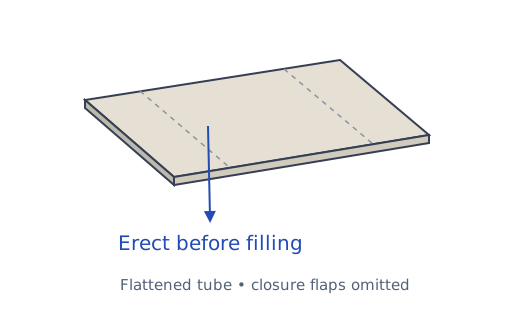
Supplied flat
Allow for erection, closure and product loading at the packing site.
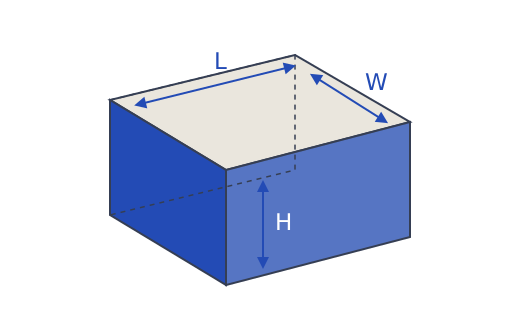
Supplied formed
Confirm occupied transport volume, packing protection and remaining filling work.
03 / The cost guide
Unit price vs total order cost
Keep three numbers on your budget sheet. The production price is what the quoted manufacturing scope costs per pack. An effective unit cost spreads the specified one-time work over the order. A project budget adds the other explicitly included costs.
- Production subtotal
- Q × U
- Effective unit cost before freight
- (Q × U + S + D) ÷ Q
- Included project budget
- Q × U + S + D + F + O
- Budget per ordered pack
- Included project budget ÷ Q
Q is the number of complete packs ordered; U is the production price per pack. S is separately charged setup, D is development and samples, F is separately charged freight, and O is other explicitly budgeted costs. All amounts must use one currency and the same tax basis. Q must be greater than zero.
The denominator is ordered packs, not units sold. If fewer packs are usable, calculate that separately with the usable quantity. A larger order can spread fixed work more thinly while increasing cash outlay and inventory. The useful purchasing question is how much stock you can use, not only how low U can go.
04 / The cost guide
A worked budgeting example
Illustrative example only — not a Foldelle quote or market benchmark.
Assume an order of 1,000 complete packs in USD at an invented production price of $2.40 each. For this exercise only, that price includes the box, printing, one paperboard insert, packaging assembly and transport cartons. Assume separate setup of $300, sample development and sample delivery of $120, and order freight of $480.
| Cost line | USD |
|---|---|
| Production1,000 × $2.40 | $2,400.00 |
| One-time setup | $300.00 |
| Sample development & delivery | $120.00 |
| Order freight | $480.00 |
| Included project total | $3,300.00 |
Illustrative inputs; same values as the table. Every bar starts at zero; the longest bar represents USD $2,400.00.
The arithmetic is $2,400 + $300 + $120 + $480 = $3,300. Production alone is $2.40 per pack; adding the assumed setup and samples gives $2.82; adding order freight gives $3.30. These are three scopes of the same order, not competing prices.
Excluded: product filling, onward customer deliveries, taxes, import charges, brokerage, warehousing, financing and contingency. No allowance for those items has been invented. Confirm any that apply before approving a purchase. All dollar inputs above are assumptions; only the arithmetic is calculated. The technical sources explain processes, not these prices.
05 / The cost guide
How to compare packaging quotes fairly
Send both suppliers one versioned brief. Put their answers against these lines, and mark any mismatch before comparing totals. Request a revised offer where the scopes differ; do not quietly treat an unspecified component as equivalent.
- Fit & structure
- Same internal length × width × height, dimensional units, tolerance, opening and closure; reference the same drawing revision.
- Material
- Same named board or agreed grade, grammage, caliper and wrap. Record any proposed substitute as a separate option.
- Print & finish
- Same artwork revision, printed sides, colour requirements, coverage, coating and finish areas; same proof expectations.
- Insert & accessories
- Same material, cavities and components. Confirm whether inserts arrive fitted, loose or separately packed.
- Quantity & versions
- Same quantity per size and artwork version. Clarify permitted overrun or underrun, what is invoiced and what is delivered.
- Sample & setup
- Same sample scope, revisions and delivery; itemised one-time charges, possible repeat-order charges and ownership or storage of tooling.
- Assembly state
- Same formed or flat condition, gluing and packing scope. State explicitly whether product loading is excluded.
- Delivery & commercial scope
- Same currency, delivery location, shipping service, named delivery terms where used, included charges, exclusions and quote validity.
The quote that looks cheaper
Imagine one offer includes a fitted insert and delivery to your warehouse, while another covers flat boxes collected at the supplier. They solve different portions of the job. Ask the second supplier to price the missing scope, then add any work your own team must do. Until those answers arrive, the apparent gap is a scope gap—not a demonstrated saving.
06 / The cost guide
How to reduce costs without compromising essential requirements
Work through this sequence before chasing a lower unit price. Keep product protection and required presentation fixed, then ask what each alternative changes in the complete budget.
Validate the fit
Remove avoidable empty space while retaining clearance, cushioning and handling access. Ask for a revised blank and shipping-pack layout; a smaller-looking box is not proof of a lower total.
Simplify the structure
Compare a straightforward closure against a more involved reveal. Keep the protection requirement fixed so you can judge the presentation trade-off separately.
Rank the finishes
Keep the detail customers notice first and price optional interior printing or secondary finishes separately. Request an actual revised quote instead of assuming a saving per removed effect.
Revisit the insert
Seek fewer parts and intuitive loading where feasible. Test product restraint and surface contact; an insert that saves assembly effort but allows damage fails the brief.
Share specifications carefully
Consider a common outer pack across compatible products, with different locating pieces or artwork. Extra void space or a second insert can erase the benefit of fewer box formats.
Align quantity with demand
Compare purchasing against a realistic consumption window. Include stockholding and the likelihood of a label or product change before increasing the order.
Plan delivery and receipt
Compare viable transport services and flat versus assembled supply together with packing capacity. Consolidation only helps if scheduling, space and handling remain workable.
07 / The cost guide
What to send for an accurate quote
Copy this brief into your enquiry. Write “open” beside unknowns and identify which features are essential. Ask the supplier to state the assumptions behind any provisional estimate.
Copy-ready enquiry checklist
Product and use: [product, sales channel, protection requirements]
Product dimensions, weight and tolerances: [units]
Pack: [structure, internal L × W × H, drawing revision]
Materials and insert: [specified / open to alternatives]
Artwork: [revision, printed sides, colours, coverage]
Finishes: [type, area, must-have / optional]
Quantity: [per size and artwork version; replenishment plan]
Supply state: [flat / formed; insert fitted / loose]
Samples: [what needs to be checked and approved]
Delivery: [country, postcode, receiving constraints, required date]
Please itemise setup, samples and freight; identify all inclusions, exclusions and quote validity.
08 / The cost guide
Custom packaging cost: common questions
Why is the first order sometimes more expensive?
Initial tooling, development and sample approval can add costs that are not all repeated. Reorders can still need setup, new proofs, replacement tooling or material checks. Ask which charges can recur and whether the design must stay unchanged for tooling to be reused.
Does a larger order always mean a lower total cost?
No. Even if the production price per unit falls, you are purchasing more units. Compare total cash required, your expected usage and storage needs. A minimum order quantity is a production condition to clarify, not a recommendation to buy more than you need.
Are inserts and shipping included in box prices?
Only when the quote says so. One supplier may quote a complete set while another prices the shell alone. Ask for a written inclusion list and a named delivery location. Do not add an estimated shipping line to a price that already includes that same transport.
Can I get an estimate before finalising artwork?
You can request an indicative estimate using a defined structure, size, material direction, quantity and provisional print or finish scope. Mark unresolved choices. Treat the result as conditional, then obtain a revised quote after artwork, sampling requirements and delivery details are confirmed.
How should I handle an unpriced cost?
Keep it visibly open and assign someone to confirm it. If you reserve a planning allowance, label it as your own assumption, separate from supplier charges. Check currency and tax treatment consistently; a missing freight or import-cost line is not evidence that it is included.