The packaging journal Buying guide
Rigid Boxes vs Folding Cartons: Which Is Right for Your Product?
Two structures. Different strengths.
A practical guide to presentation, protection and the decisions behind a useful packaging brief.
By Foldelle Packaging · · 14 min read
Compare the options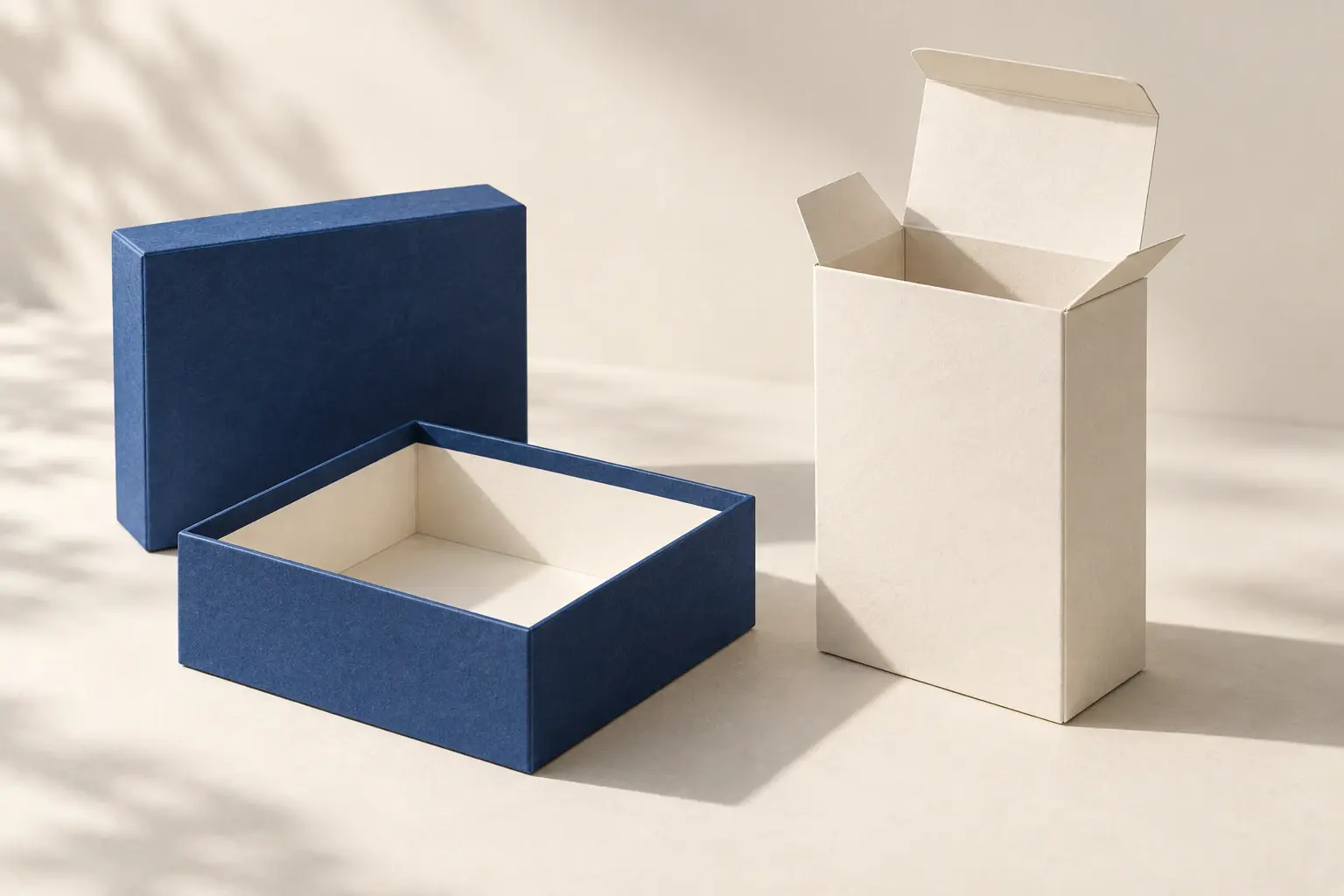
Start here
The short answer.
Rigid boxes use a substantial board structure, usually covered with a separate paper wrap; folding cartons use cut and creased paperboard that can be supplied flat and erected for packing. Choose rigid boxes when a structured presentation and deliberate opening experience justify the space and cost. Start with folding cartons when shelf communication, compact storage and efficient replenishment matter most. Neither format guarantees transport protection: the product, insert, closure and shipping pack must work together. Some rigid boxes also fold flat.
01 / Form follows function
Understand the structures
A traditional rigid box, also called a set-up box, has a thick paperboard core with a separate decorative wrap. A folding carton is formed from a die-cut, creased paperboard blank, commonly supplied as a flattened, pre-glued sleeve. The Paperboard Packaging Council’s format overview explains this distinction. Here, “folding carton” means conventional non-corrugated paperboard packaging, rather than a corrugated shipping box.
The rigid box.
A formed lid and base. A substantial board core. A separate wrap that defines the surface.
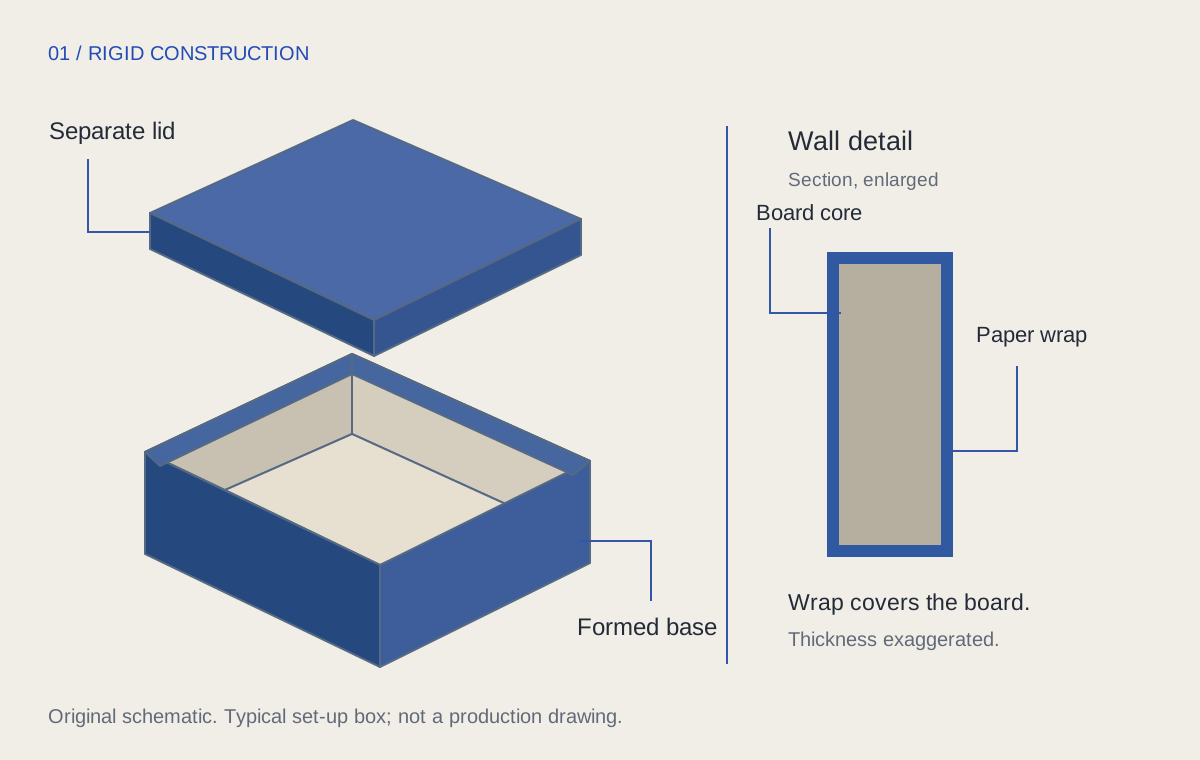
Rigid construction supports lift-off lids, drawers and hinged presentations. Explore rigid box structure options to see how the opening changes the product layout. Conventional set-up boxes retain their shape; collapsible magnetic box designs use folding sections and fastening details to allow flat supply. Specify which version you mean when requesting quotes.
The folding carton.
Panels, crease lines and closure flaps turn a flat paperboard blank into a product pack.
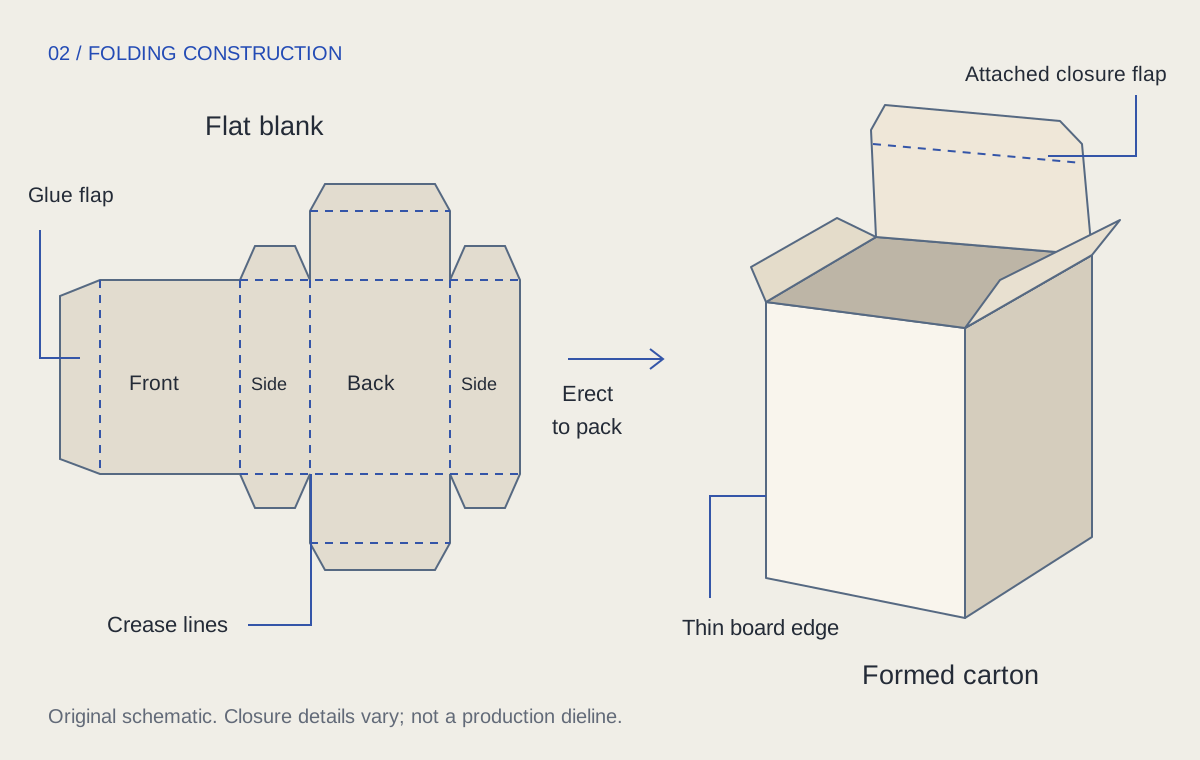
For cartons, the blank defines the panels, crease lines, glue flap and closures. Tuck ends and auto-lock bottoms create different packing workflows. Compare folding carton closure options against product weight, loading direction and available equipment. A carton arriving flat may already have its side seam glued.
02 / At a glance
Compare the buying trade-offs
Use these tendencies to shortlist a format. The specification checks under each dimension identify what to confirm before committing.
| What matters | A Rigid boxes | B Folding cartons |
|---|---|---|
| StructureConfirmConventional or collapsible rigid construction; carton closure and loading direction. | Rigid boxesThick board covered with a separate paper wrap; a formed lid, drawer or hinged presentation. | Folding cartonsDie-cut, creased paperboard forms panels and closure flaps; the side seam may arrive pre-glued. |
| PresentationConfirmOpening feel, product access and brand fit; stock compatibility and physical proofs. | Rigid boxesSubstantial walls; controlled lid or drawer reveal. Decoration on the wrap and interior surfaces. | Folding cartonsCompact shelf pack; clear printed panels. Decoration on carton panels. |
| Inserts and protectionConfirmComplete packed-product performance, distribution route and testing requirements. | Rigid boxesStiff walls can support a protective design. May need an outer shipping box. | Folding cartonsBoard, geometry and inserts support protection. May need an outer shipping box. |
| Storage and assemblyConfirmCollapsible options, bundles and pallet layout; actual packing time, staffing and equipment. | Rigid boxesConventional boxes occupy assembled volume. Set-up shell is formed; inserts and loading remain. | Folding cartonsFlat supply reduces space before filling. Erection and closure required. |
| Cost driversConfirmTooling, finishes, size and production route; minimum per size, artwork and material. | Rigid boxesBoard, wrapping and assembly add cost. No universal minimum order quantity. | Folding cartonsOften economical for repeat production. No universal minimum order quantity. |
| Typical applicationsConfirmThese are starting points, not rules. Product, channel and budget can change the choice. | Rigid boxesGift sets, jewelry presentation and products where a substantial opening experience matters. | Folding cartonsSkincare retail packs, fragrance cartons and small accessories where shelf fit and replenishment matter. |
| Materials and recyclingConfirmComplete material mix and local acceptance; neither category is automatically more sustainable. | Rigid boxesWraps, adhesives and fitments affect assessment. | Folding cartonsCoatings, windows and inserts affect assessment. |
A buying framework, not a performance rating. Both formats may require an outer shipping box.
03 / Surface & experience
Plan the presentation
Start with the encounter you are designing. A retail carton needs readable information, a useful shelf footprint and easy replenishment. A gift box may need to reveal several pieces in sequence and look composed after opening.
Both formats can use printed graphics, foil and embossing. A rigid box offers depth and a substantial edge; a carton can achieve a refined result through proportion, typography and carefully chosen stock. Review paper, print and finish options together, since a finish that works on one surface may behave differently on another.

Look beyond the flat artwork.
Review the fold, the edge and the finished surface.
Approve appearance on a formed sample. Examine wrap seams and corners on rigid boxes, and crease appearance and flap alignment on cartons. Holmen’s Paperboard Manual explains that consistent die-cutting and creasing depend on the board, tooling, machine settings and material conditions. A flat artwork proof cannot establish how the finished folds will look.
04 / Fit & performance
Specify protection as a system
A box that resists a squeeze is not automatically a validated shipping solution. It can still allow a bottle to strike another component, a cap to carry an impact, or a polished surface to rub against an insert.
Design around the product’s failure points. Locate fragile projections, moving parts and surfaces that must remain pristine. Then specify where the insert supports the product, how it limits movement and how the customer removes it. Paperboard, molded pulp and foam are possible approaches; selection needs a product-specific assessment, including material contact and packing work.
Distinguish retail distribution from individual parcels. A product carton moving inside a wholesale shipping case encounters a different system from a gift box sent individually to a customer. Either format may need a corrugated outer box, cushioning and a suitable closure.
Agree on a test plan for the complete packed product. ISTA’s test-procedure overview describes transport simulation protocols and identifies Procedure 3A for relevant parcel-delivery applications. Ask the testing provider which protocol matches your route; citing ISTA does not mean a proposed box has passed a test.
Define acceptable results too: an intact product and a gift-ready presentation are different acceptance criteria. Record the tested configuration so a later insert or shipping-box change triggers a review.
05 / The complete cost
Compare costs and quantities
Folding cartons often offer a lower production unit cost, but the practical comparison is the cost of getting a correctly packed, saleable product to its destination.
Request an itemized quote covering the shell, print, finishing, insert, sample development, tooling, packing and delivery terms. For rigid boxes, pay attention to wrapping, multiple components and assembly. For cartons, examine cutting tools, print setup, sheet layout and gluing requirements. A complex carton and a simple rigid box should not be compared using category averages.
Higher quantities can spread setup costs over more units. They also commit cash and warehouse space, particularly when artwork or product dimensions may change. Ask for prices at quantities you could actually sell through, and clarify whether each artwork version counts as a separate run. There is no reliable universal MOQ or quantity at which one format becomes the better purchase.
Build a project cost sheet with separate lines for supplier charges, inbound freight, receiving and storage, packing labor, outer shipping materials and outbound delivery. Include applicable duties and taxes without double-counting amounts already included in the quote. Assess obsolete stock and replacement shipments separately using your own records. This makes a lower box price easier to judge against the work it creates elsewhere.
06 / Two different journeys
Account for storage, freight and assembly
Space before filling.
Compare case dimensions, flat supply and the work needed to form each pack.
Space after filling.
Measure the complete shipping pack and validate it for the intended route.
Separate two journeys: empty packaging arriving at your packing site, and packed products leaving it. Flat cartons can reduce the first journey’s space requirement. Once erected and filled, they occupy their finished dimensions; “ships flat” does not describe the customer parcel.
Ask for the supplier’s actual shipping-case dimensions, quantities per case, weights and pallet arrangement. Conventional rigid boxes generally consume more empty-pack space, but collapsible designs change that comparison. Request a demonstration of erection and fastening, and check whether the proposed insert also stores flat.
For outbound parcels, measure the finished shipping pack. FedEx’s dimensional-weight explanation shows why occupied space can affect billing as well as actual weight. Confirm the rules for your carrier, service and account instead of applying a universal divisor.
Finally, time a realistic packing trial. Include fetching components, erecting the box, installing the insert, loading, closing and correcting mistakes. A pre-formed rigid shell still requires handling; a pre-glued carton may assemble quickly. The useful figure is your team’s completed packs per working period, not a theoretical folding speed.
07 / The whole material mix
Evaluate materials and recyclability
Neither category is automatically the more sustainable choice. Compare designs that deliver the same product protection and use, then examine material consumption, transport, likely reuse and end-of-life options.
Recyclability concerns the finished package. Cepi’s paper-based packaging recyclability guidelines explain that coatings, laminates and combinations with other materials can complicate paper recycling. They also emphasize differences between collection systems and national assessment protocols.
Ask for a component list covering the board, wrap, coating, adhesive, window, magnets, ribbons and insert. Identify which parts consumers can separate and check acceptance in the intended market. A paper-looking surface does not establish that the complete pack belongs in a local paper recycling stream.
A keepsake function may be useful, but do not assume customers will reuse a box or that reuse cancels its production impact. Likewise, lower material weight alone does not establish a lower overall environmental impact. Prefer specific, supportable descriptions over blanket “eco-friendly” claims.
08 / From principle to product
Apply the decision to three products
The following are hypothetical purchasing scenarios, not customer cases or tested specifications.
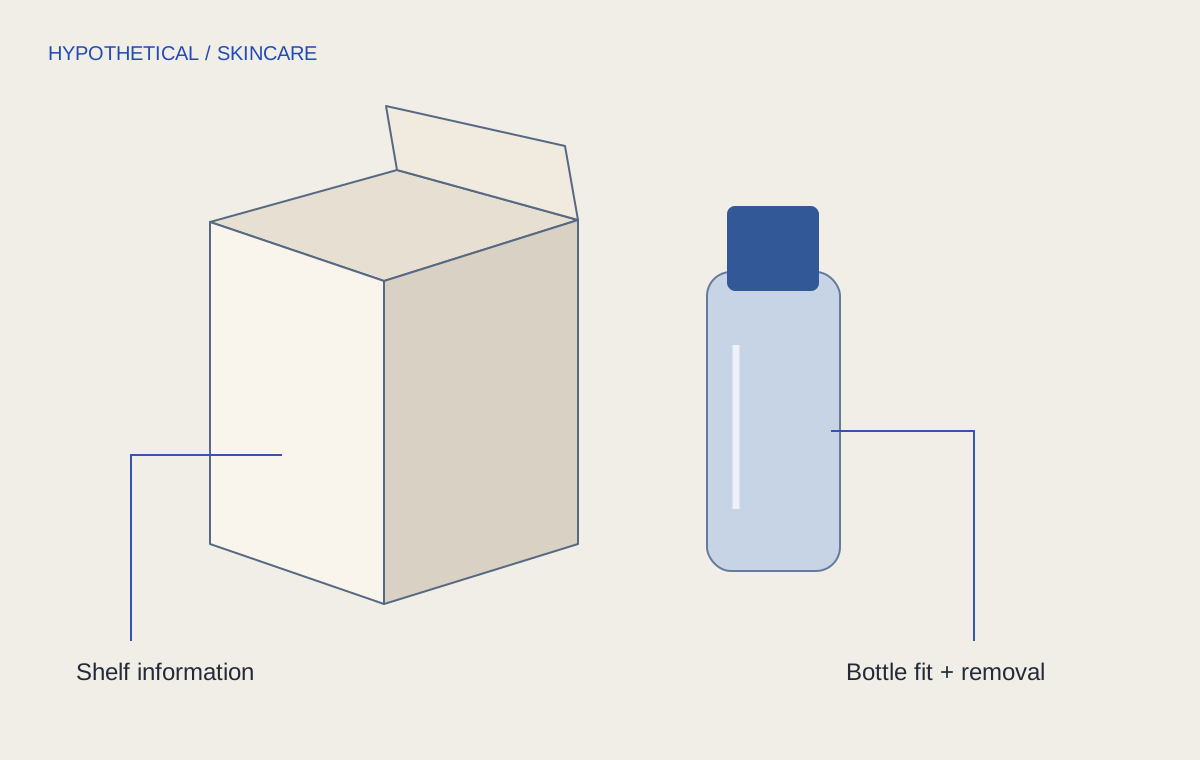
Scenario 01 / Hypothetical
Skincare retail product
Assumption: A brand sells a single serum bottle with several artwork variants, regular store replenishment and limited packaging storage. Start by sampling a folding carton with an insert that locates the bottle. Check shelf information, packing speed and bottle removal. For online orders, validate the carton inside the intended shipping pack. Consider rigid packaging separately for a gift edition if its presentation role earns the extra handling and space.
- Priority
- Shelf clarity + repeat replenishment
- Consider
- A folding carton with a locating insert
- Revisit if
- A gift edition with a different presentation role

Scenario 02 / Hypothetical
Fragrance gift set
Assumption: A seasonal set combines a glass fragrance bottle and a travel spray, and the coordinated reveal is part of the offer. Start with a rigid presentation box and a fitted insert that separates the components. If empty-pack freight is restrictive, compare a collapsible version and trial its assembly. A refined carton remains an alternative if the rigid proposal exceeds the budget; neither route removes the need to validate glass protection.
- Priority
- A composed reveal + separated components
- Consider
- A rigid presentation box with a fitted insert
- Revisit if
- Restricted empty-pack freight or budget
Scenario 03 / Hypothetical
Jewelry packaging
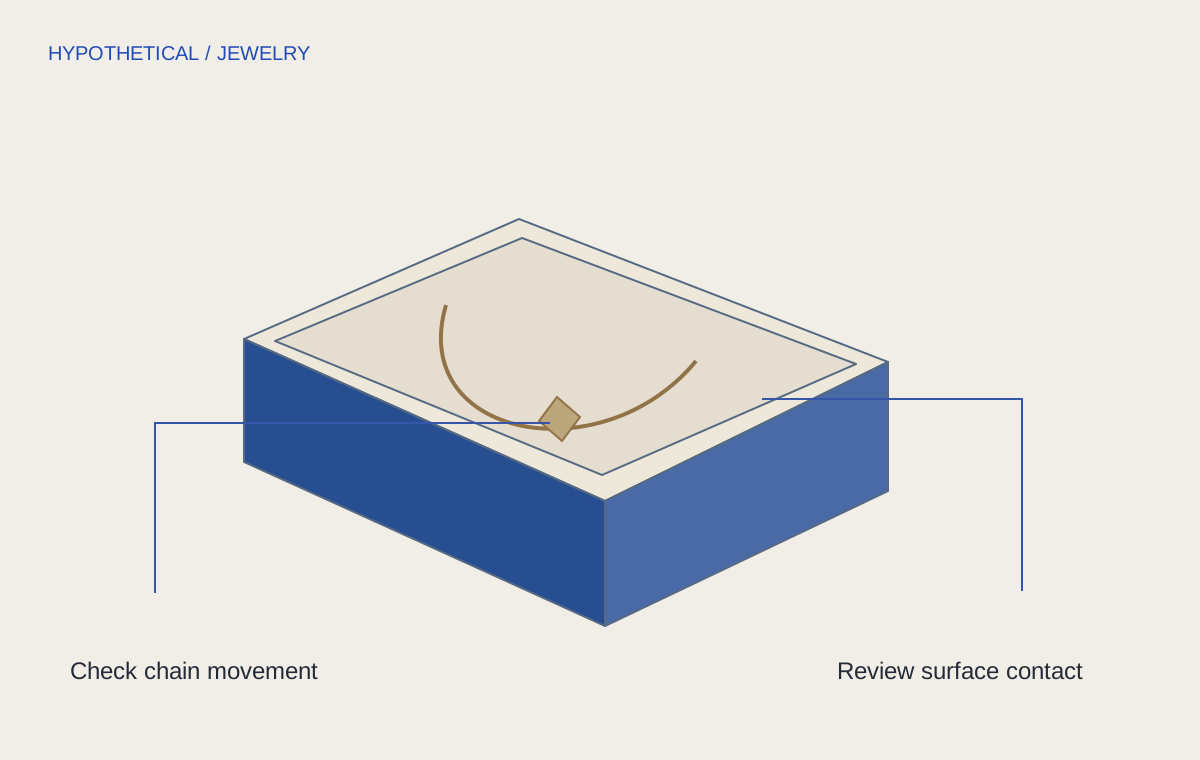
Assumption: A brand sells a delicate pendant, and some buyers want a box for storage or gifting while others want minimal packaging. Sample a compact rigid box for the gift option and a folding carton with a suitable jewelry support for standard orders. Check chain movement, surface contact and removal. Decide whether maintaining both formats is justified by demand and inventory complexity, rather than treating every jewelry order as identical.
- Priority
- Controlled movement + gentle surface contact
- Consider
- Rigid for gifting; a supported carton for standard orders
- Revisit if
- Demand and the complexity of holding two formats
09 / Your next packaging brief
Which should you choose?
Let the presentation need guide your shortlist. Let the complete specification decide.
Before approving either format:
- Define the product and channel. Record dimensions, weight, vulnerable features and the route to the customer.
- Name the presentation requirement. Decide whether a substantial reveal or compact shelf pack matters more.
- Shortlist a structure. Lead with rigid for presentation needs or a carton for shelf and replenishment needs; compare both if priorities conflict.
- Check practical constraints. Confirm quantities by artwork, storage, assembly labor, delivery timing and total project cost. Revisit the shortlist if these do not fit.
- Validate the complete pack. Review product fit, appearance, packing workflow and agreed transport performance before approval.
The strongest brief explains what the package must do and where it will travel. That gives a supplier a useful basis for recommending a structure.
10 / Before you specify
Frequently asked questions
Can I use the same artwork for both formats?
You can retain the visual identity, but production artwork needs a separate layout. Carton folds, glue areas and tuck flaps differ from rigid-box wraps and turn-ins. Approve the structural drawing first, then adapt artwork to the confirmed dieline and decoration areas.
Which sample should I request first?
Start with a structural sample if fit or opening is unresolved. Use the actual product to assess loading and removal, then review a representative decorated sample. Confirm any differences between sample materials or processes and intended production; one sample may not answer every question.
Can I switch formats without changing the insert?
Sometimes, but do not assume interchangeability. Internal dimensions, wall thickness, lid clearance and loading access can change even when the outside looks similar. Recheck retention and removal, then assess whether the changed pack requires renewed transport testing.
Is an auto-lock bottom suitable for a heavy product?
It may be, but the closure name is not a load rating. Suitability depends on the board, dimensions, glue construction and packed product. Ask for a representative sample and an assessment of the base under the intended handling conditions.
Which format has the shorter lead time?
Neither is always faster. Stock availability, tooling, print route, finishing, assembly and factory scheduling determine the timetable. Ask for a schedule that separates sample approval, production and freight, and clarify what happens if artwork approval is delayed.
11 / Behind the guide
Sources & further reading
Technical sources reviewed on 8 September 2026. Their scope is described alongside the relevant facts above.
- Paperboard Packaging CouncilFormat definitions and construction
- Holmen · Paperboard ManualBoard, tooling and creasing conditions
- ISTA · Test ProceduresTransport simulation and parcel test scope
- FedEx · Dimensional weightHow parcel volume can affect billing
- Cepi · Recyclability guidelinesMaterial combinations and local collection systems
All packaging visuals are original concepts or schematics. They do not show Foldelle customer projects, manufactured samples or test results.