The packaging journal — RFQ guide
How to Request aCustom Packaging Quote:10 Details Your Supplier Needs
Turn an early packaging idea into a brief suppliers can price, compare and move toward sampling.
By Foldelle Packaging · · 11 min read
Build your RFQ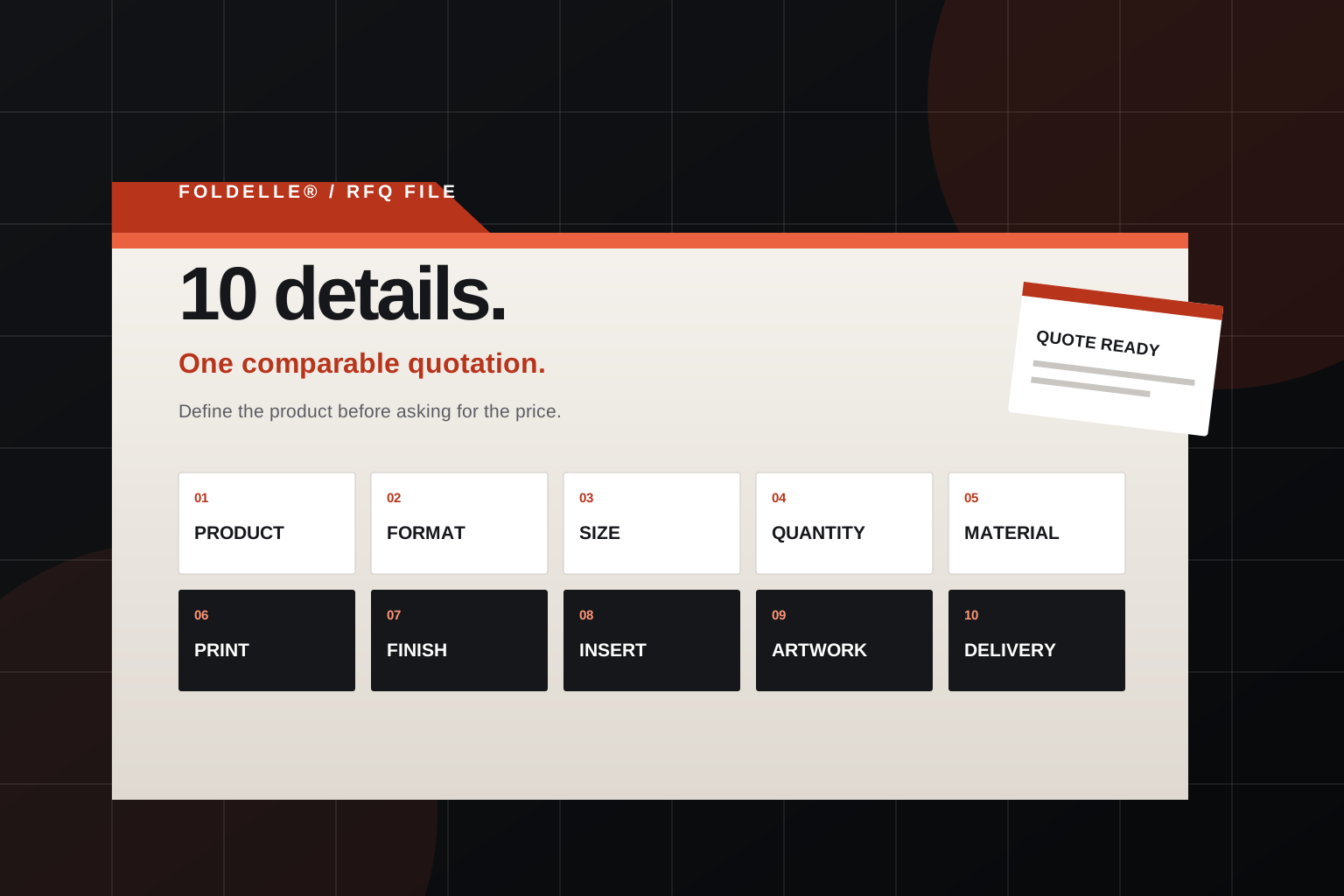
Price follows specification
“How much does a custom box cost?” is the start of a brief—not a complete quote request.
A custom box quotation is built from choices: size, board, printing, finishes, insert, quantity and delivery. Without them, a supplier can only make assumptions, and two suppliers may price entirely different packs while appearing to answer the same question.
A clear brief does not require specialist packaging knowledge. It simply separates confirmed facts from preferences and open questions. That reduces repeated emails, unsuitable quotations and artwork revisions—and makes the next step, sampling, much easier to define.
Concise answer
What information do you need for a custom packaging quote?
Send these ten details. If one is undecided, label it “open to recommendation” instead of inventing a specification.
- 01Product
- 02Packaging format
- 03Dimensions
- 04Quantity
- 05Material
- 06Printing
- 07Finishes
- 08Insert
- 09Artwork
- 10Destination + date
01 / The item inside
Describe the product being packaged
Name the product, its intended use and where the finished pack will appear: retail, ecommerce, gifting or promotion. Provide maximum product dimensions and weight, then flag glass, pointed edges, delicate coatings, liquids, heat sensitivity or an irregular shape. These facts influence board strength, closure and insert design.
Say whether a physical product sample is available. For a complex bottle, jewelry set or multi-piece kit, a sample may be the safest way to develop the fit. Photos from several angles help at quotation stage, but they do not replace exact measurements.
02 / Choose or compare
Identify the packaging format
State the preferred structure: rigid box, magnetic closure box, folding carton, mailer box or paper bag. Include a reference image when terminology is uncertain. A structure affects material use, assembly, packing speed, storage and shipping—not only appearance.
If you have not chosen, explain the product, channel and desired opening experience, then ask the supplier to compare two suitable formats. “Premium gift box that can ship inside a mailer” is a useful requirement; “something luxurious” is still too broad.
03 / Measure the fit
Provide product and packaging dimensions
Write dimensions as length × width × height and include the unit. Product dimensions describe the item; internal box dimensions describe usable space; external dimensions include the structure itself. Label every measurement so they cannot be confused.
Allow space for paperboard or foam inserts, tissue and other protection, but do not add arbitrary clearance. Too little causes fit problems; too much increases material and freight volume. Approximate dimensions are acceptable for an early budget range only—mark them as estimates and update the quote before sampling.
- Product
- Maximum L × W × H + weight
- Internal pack
- Usable space after inserts
- External pack
- Finished shipping footprint
04 / Quote the real run
State the initial order quantity
Quantity affects production method, setup allocation and unit cost. Give the intended first run and a realistic reorder quantity; ask for relevant tiers only, such as 300 / 500 / 1,000, rather than ranges you would never buy.
Minimum quantities vary by structure, dimensions, material, printing and finishing. Share your target quantity so Foldelle® can assess suitable production options and confirm the minimum for your specification. For a deeper cost discussion, see our custom packaging cost guide.
05 / Performance before finish
Define the material and performance requirements
Specify board type or thickness if known, but also describe the result required: rigidity, crush resistance, low weight, a smooth print surface or a tactile uncoated feel. Coated, uncoated and textured papers can reproduce color differently, while shipping humidity and warehouse conditions may affect the needed construction.
If you are unsure, ask for a recommendation and explain the trade-off you want the supplier to optimize. Browse Foldelle’s materials and finishes overview for useful vocabulary, then confirm final selections with samples rather than unsupported performance or sustainability assumptions.
06 / Define every printed face
Specify the printing requirements
State whether the exterior, interior or both are printed; how many colors are involved; and whether artwork is full coverage or limited to a logo and text. Add placement notes and a color reference. CMYK builds color from process inks, while a Pantone spot color can be specified when tighter brand-color control is important. Pantone’s official color-space guide explains the distinction.
A screen reference is not a physical print standard. If an existing package or approved swatch matters, mention it and ask how it should be supplied for matching.
07 / Decoration with consequences
List the required finishes
List matte or gloss lamination, foil stamping, embossing, debossing, spot UV, specialty paper or texture separately. Mark each as required or optional. Every added operation may affect tooling, register tolerances, feasibility, cost, minimum quantity and timing, so request a simpler alternative when the effect matters more than the exact technique.
08 / Hold and protect
Explain the insert and protection needs
Tell the supplier whether the product needs a paperboard insert, foam or another protective component; whether a set needs multiple compartments; and which surfaces must stay visible. The insert should prevent movement during packing and transit without making removal frustrating.
Share the exact product geometry and orientation. A physical product may be needed to develop retention around curved, tapered or irregular shapes. Also state whether the insert must arrive pre-assembled and whether the packer needs finger notches, pull tabs or space for instructions.
09 / Show the intent
Share artwork and visual references
Attach vector logos, brand color specifications, any existing dieline and relevant mood-board images. Label inspiration as inspiration—an image may show a color mood while the confirmed structure is different. This prevents references from becoming accidental specifications.
Before sampling, review artwork on the supplier’s dieline. Check bleed, safe areas, fold lines, text size, image resolution and font handling. Adobe’s official guidance on printer’s marks and bleed is a useful reference. A digital preview helps catch placement errors, but it does not prove physical color or material feel.
10 / Plan backward
Provide the delivery destination and target date
Give the country, postal code and whether delivery is to a commercial or residential address. State the required arrival date—not only the desired production-completion date—and ask whether the quotation includes export cartons and freight.
Air may support smaller or urgent shipments; sea may suit larger, less time-sensitive volume. Freight can be affected by space as well as actual mass: UPS’s official volumetric-weight guide explains the principle. Work backward through specification, sampling, production, inspection and transit, allowing room for decisions rather than relying on a universal lead time.
11 / Normalize the assumptions
Why two packaging quotes may look very different
One quotation may assume thinner board, process printing and no insert; another may include a Pantone color, tooling, printed sample, export cartons and freight. Unit prices are not comparable until dimensions, quantities and inclusions match.
Compare total project cost on the same approved specification; record every exclusion and one-time charge.
12 / Copy and complete
A custom packaging RFQ template
Paste this packaging RFQ checklist into an email or project document. Use “open to recommendation” wherever a decision has not yet been made.
Product:
Product dimensions and weight:
Preferred packaging format:
Required internal dimensions:
Initial order quantity:
Expected reorder quantity:
Material preference:
Printing requirements:
Finishes:
Insert requirements:
Artwork status:
Delivery country and postal code:
Target arrival date:
Reference images:
Additional requirements:13 / Hypothetical example
Example of a clear packaging brief
Fictional illustration only — not a customer case, quotation or production commitment.
Project / beauty launch
Two-piece skincare gift set
A premium ecommerce gift pack for one 50 ml glass jar and one 30 ml glass bottle, both supplied as physical samples.
- Format
- Rigid lift-off-lid box; alternative magnetic format welcome
- Quantity
- 500 initial / 1,500 expected reorder
- Material
- Wrapped rigid board, matte warm-white paper; thickness open to recommendation
- Print + finish
- One-color exterior logo, copper-color foil; unprinted interior
- Insert
- Paper-based insert preferred; retain both products during parcel shipping
- Artwork
- Vector logo and brand color supplied; dieline artwork not started
- Delivery
- Commercial address in Berlin, Germany; postal code and target arrival date supplied privately
14 / From brief to order
What happens after you submit the brief?
- 01Review
Open questions and conflicting requirements are identified.
- 02Recommend
Structure and material options are narrowed.
- 03Quote
A preliminary quotation states assumptions and exclusions.
- 04Preview
A dieline and artwork view establish placement.
- 05Sample
Structure, print and finish are checked physically as needed.
- 06Approve
The final specification becomes the production reference.
- 07Deliver
Production, inspection and international delivery are coordinated.
See the complete Foldelle project process or follow the longer idea-to-production guide.
15 / Incomplete is acceptable
How Foldelle® helps clarify incomplete packaging ideas
You do not need to arrive with a complete technical specification. Foldelle organizes the product facts and visual references you do have, then clarifies structure, dimensions, materials, printing, finishes and insert needs. Production previews and appropriate samples are reviewed before approval, and finished packaging is checked against the agreed specification.
The useful starting point is an honest brief: what is fixed, what is preferred and what still needs a recommendation.
16 / Frequently asked questions
Questions before requesting a quotation
Can I request a quote without finished artwork?
Yes. Product information, dimensions, quantity, structure preferences and visual references are enough to begin. Finished production artwork is normally prepared after the structure and dieline are confirmed.
Can Foldelle® recommend a suitable box structure?
Yes. Describe the product, sales channel, desired opening experience and delivery route. Foldelle can compare appropriate formats before you commit to one structure.
What dimensions should I provide?
Provide the product’s maximum length, width and height, plus weight. If you already know the required box size, label it clearly as internal or external and state the measurement unit.
What is the minimum order quantity?
Minimum order quantity is confirmed for your specification. Share your target quantity so Foldelle can review dimensions, material, printing, finishes and production method before quoting.
Do I need a sample before production?
A sample is strongly recommended. A structural sample checks fit and opening; a printed sample adds evidence about paper, color and finish placement. The suitable sample route depends on what remains uncertain.
Does the quotation include international shipping?
Only if it is explicitly listed. Ask whether freight, export cartons, duties, taxes and delivery to the final address are included or excluded, and confirm the applicable trade terms.
Ready to define the project?
Send the facts you have. We’ll help identify what is missing.
Share your product dimensions, target quantity, preferred packaging style, delivery destination and any visual references. Foldelle® will help clarify the remaining details required for sampling and production.
Request a custom packaging quote